The Forest That Breathes
Santosh Jha
| 30-04-2026
 · Travel team
From up here, it looks almost too perfect to be real.
A dark river twisting through a sea of dense green canopy, curving back on itself like it can't quite decide where it wants to go.
No roads. No buildings. Just water and trees and the kind of stillness you can almost feel through a screen.
This is a mangrove forest — and if you've never given much thought to one before, that's about to change. Because these tangled, salt-soaked, mud-rooted trees might be doing more for life on Earth than any forest you've ever heard of.
What Makes Mangroves So Different
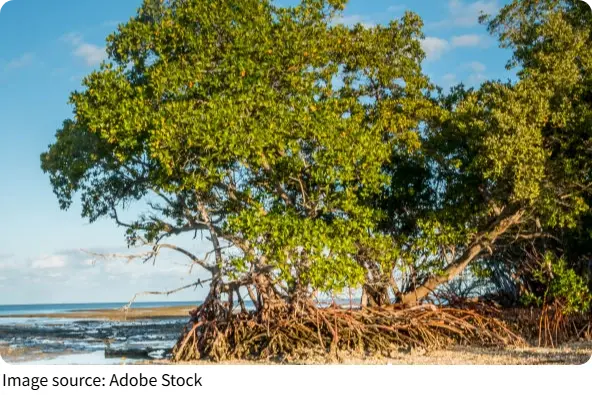
Most trees would die within days in saltwater. Mangroves don't just survive it — they've built entire ecosystems around it. Their root systems are the giveaway: instead of disappearing neatly underground, they arch and loop above the waterline in dense, exposed tangles that look almost architectural. Those roots do several jobs at once.
They anchor the tree in unstable coastal mud. They filter salt from the water. And they create an underwater labyrinth that becomes a nursery for an extraordinary variety of marine life.
Snapper, barracuda, shrimp, seahorses — an estimated 80% of the world's tropical fish species spend at least part of their lives sheltered inside mangrove root systems. The forest you're looking at from above is, from below the waterline, one of the busiest neighborhoods in the ocean.
The Carbon Number That Should Surprise You
Here's the part that tends to stop people: mangrove forests store carbon at a rate roughly three to five times higher than tropical rainforests of the same size. The secret is in the mud. When mangrove leaves and roots decompose, the carbon they contain gets locked into the waterlogged, oxygen-poor soil beneath — sometimes for thousands of years. Scientists call it "blue carbon," and it's become one of the most exciting areas of climate research in the past decade.
A single hectare of healthy mangrove forest can store upward of 1,000 metric tons of carbon. Globally, mangroves cover only around 150,000 square kilometers — less than 1% of Earth's total forest area — yet they account for roughly 10% of all carbon buried by the world's oceans. The math is staggering.
Where You Can Actually Visit One
Mangrove forests exist across tropical and subtropical coastlines worldwide, and several have become genuinely memorable travel destinations.
Palawan in the Philippines is home to some of Southeast Asia's most pristine mangrove systems. Guided kayak tours through the Puerto Princesa Subterranean River National Park weave through dense mangrove channels — tours typically cost $25–$40 per person and run in the morning when light filters beautifully through the canopy.
In Florida, the Everglades National Park contains the largest mangrove ecosystem in the western hemisphere. Kayak and canoe rentals inside the park start at around $30 for a half day. Park entry runs $35 per vehicle, and the park is open year-round from sunrise to sunset.
The Ten Thousand Islands area on the park's western edge is particularly striking from the water — channels narrow enough to touch both sides, birds nesting overhead, and the sound of almost nothing.
For accommodation near the Everglades, options in the nearby town of Homestead, Florida range from budget motels at $70–$100 per night to eco-lodges closer to $150–$200.
Everglades National Park
Why They're Disappearing — and What's Being Done
Mangroves have lost roughly 35% of their global coverage in the past few decades, largely due to coastal development, shrimp farming, and rising sea levels. The loss matters beyond ecology: coastal communities protected by mangrove belts experience dramatically lower damage from storm surges and tsunamis. The roots physically absorb wave energy in ways that concrete seawalls can't replicate.
The good news is that mangrove restoration has become one of the more successful conservation stories in recent years. Organizations across Southeast Asia, East Africa, and Latin America have found that replanting mangroves is relatively straightforward when local communities are involved — and that restored forests begin functioning ecologically within just a few years.
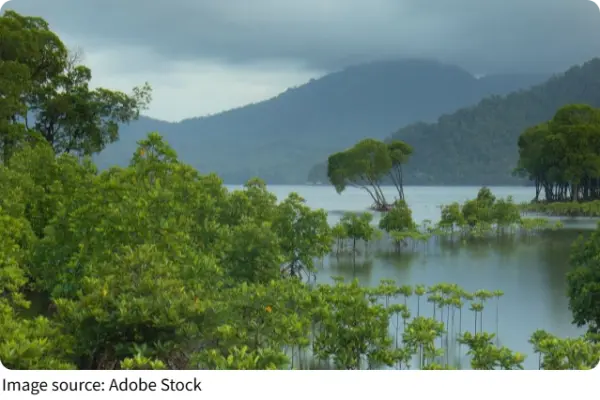
Looking at this photo — that river curving through uninterrupted green, quiet and unhurried — it's hard not to want to protect exactly this. Some places are valuable not despite being hard to reach, but because of it.